Commercial Chainlink Fence: Which Questions Should You Ask First?
Choosing a commercial chainlink fence should begin with the property’s operating needs, not simply the lowest quote. Before approving commercial chainlink fencing, clarify what the fence must accomplish, how people and vehicles will access the site, what site conditions may affect installation, and what the written scope includes.
These questions are useful for commercial property owners, facilities managers, and property managers planning work in Mississauga or the broader GTA. They can help you compare proposals meaningfully and identify unclear assumptions before installation begins. Immediate Fence Repair offers commercial chainlink fencing alongside other fence installation, repair, and maintenance services.
The Six Questions to Clarify Before You Request a Quote
| Decision area | Question to ask | Clarification to obtain |
|---|---|---|
| Function | What must the fence do for the property? | Operational, boundary, access, security, and appearance requirements. |
| Site conditions | What could affect the fence line or installation? | Layout, terrain, existing fencing, obstructions, interfaces, and work-area access. |
| Access | How will people, vehicles, and equipment move through the site? | Gate locations, access types, frequency of use, and operational priorities. |
| Materials and design | Which choices suit the property and its expected use? | Recommended options, intended application, appearance, and maintenance implications. |
| Quote scope | Exactly what work is included? | Fence areas, gates, preparation, removal, materials, exclusions, assumptions, and change procedures. |
| Maintenance | Who will look after the fence after installation? | Inspection, reporting, gate checks, repairs, and future maintenance access. |
1. What Must the Commercial Chainlink Fence Do?
A chainlink fence can serve different commercial purposes, and those purposes affect the questions you need to ask next. A property may need a clearly defined boundary, controlled entry points, separation between operating areas, or a visible barrier around equipment and storage areas. Appearance and privacy may also matter where the fence is visible from neighbouring properties, customer routes, or public areas.
Ask whether the priority is boundary definition, access control, site separation, security, appearance, or several of these. Identify which areas must be enclosed, who will use them, and whether employees, customers, contractors, delivery vehicles, or equipment need regular access. Do not assume a standard chainlink layout will meet every security, privacy, or operational requirement. Explain the property’s actual use and ask which options suit that purpose.
2. What Site and Boundary Conditions Need Review?

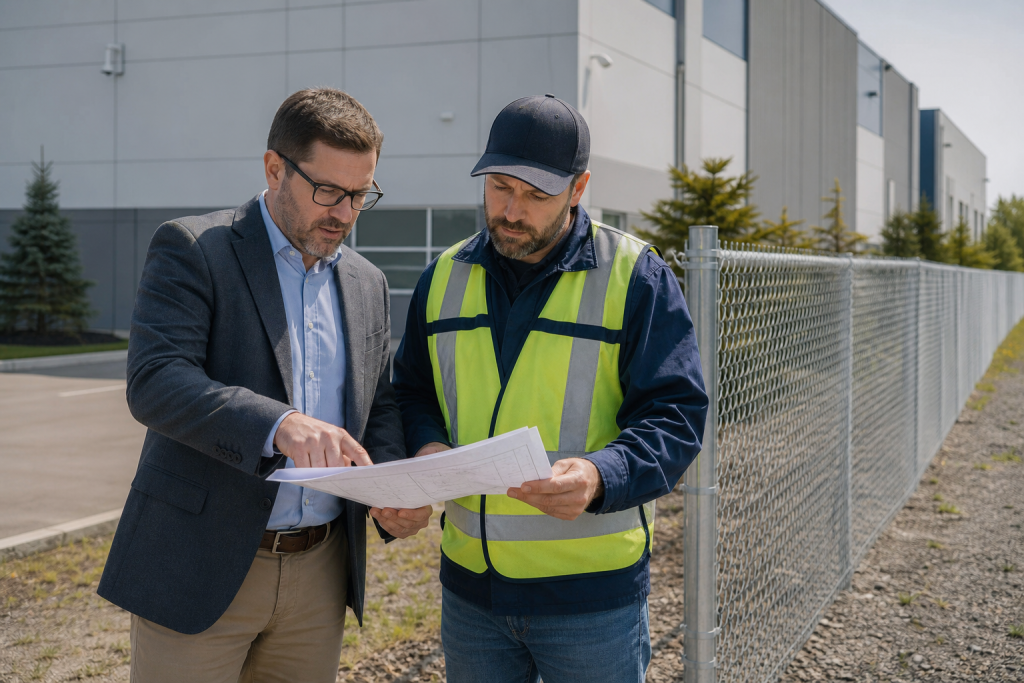
A quote can be difficult to compare if the proposed fence line is based only on a rough measurement. Ask the contractor to review the approximate fence line, terrain, existing fencing and gates, obstructions, neighbouring interfaces, and access for workers, materials, and equipment.
Also identify uncertain boundaries, connection points, restricted work areas, and locations where multiple parties need to approve the layout. This does not replace professional confirmation of property-specific requirements. It helps ensure the proposal reflects the site you actually need fenced.
3. How Will People, Vehicles, and Equipment Move Through the Site?
Access points should be planned with the fence, not added after the main layout. Discuss employee, visitor, delivery, service, pedestrian, and equipment movement before accepting a proposal.
- Where do each of these users need to enter?
- Which access points are used most often?
- Are occasional service openings required?
- Should pedestrian and vehicle movement use different points?
- Who will inspect and report gate problems afterward?
Ask the contractor to show every proposed gate and access point clearly on the quote or site plan. A fence should support daily operations, not make them unnecessarily difficult.
4. Which Material and Design Choices Suit the Property?
“Chainlink” describes the general fence type, but material and design choices still depend on the property, expected use, visual setting, and maintenance approach. Ask which options are recommended, why they suit the site, how they will look in customer-facing areas, and what maintenance considerations apply.
Avoid assuming two proposals are equivalent because both describe chainlink fencing. The selected materials and finish should be identified clearly in writing. Review Immediate Fence Repair’s general chainlink fencing services while preparing questions for a commercial assessment.
5. What Should the Written Commercial Fence Quote Include?
The written scope makes a project easier to review and approve. Before accepting a commercial fence installation proposal, check that it identifies the fenced areas, layout, gates, preparation or removal work, materials and finish, owner responsibilities, exclusions, assumptions, payment terms, and the process for approving changes.
Ask for clarification wherever wording could be interpreted in more than one way. Immediate Fence Repair uses project-based quotes rather than publishing fixed pricing, so a site-specific discussion and clearly defined scope are important. Use the company’s contact page to begin that conversation.
6. Who Will Handle Fence Maintenance After Installation?
Maintenance responsibility is easy to overlook when the immediate concern is securing a boundary. Clarify who will conduct visual checks, report damage, inspect gates, address vegetation or stored materials near the fence, and coordinate repairs.
There is no single maintenance arrangement for every commercial property. The right approach depends on site activity, exposure, access, and internal responsibilities. The important point is to assign ownership and understand available repair or maintenance support before the project is complete.
What Information Should You Prepare for the Assessment?
- Property address and project contact.
- Reason for the fence, such as boundary definition, access management, separation, or security.
- Approximate fence lines and areas to enclose.
- Known gates, delivery routes, pedestrian routes, and equipment access points.
- Photos, site plans, and notes about damage, obstructions, or constrained areas.
- Preferred appearance and customer-facing considerations.
- Operating requirements that could affect access during the work.
- Decision-makers who must approve the design and quote.
These details help the contractor ask better questions, but they do not replace an on-site review. The final proposal should reflect confirmed conditions.
How Should You Evaluate a Commercial Fence Contractor?
Evaluate providers on more than availability or headline price. Look for demonstrated commercial chainlink capability, willingness to assess the property, clear project-based quoting, responsive communication, stated use of quality materials and skilled craftsmanship, and a practical approach to follow-up, repairs, or maintenance.
Immediate Fence Repair is a Mississauga-based fence and deck company serving residential and commercial clients across the GTA. Its company information emphasizes fast response times, quality materials, skilled workmanship, and a satisfaction guarantee. Specific suitability still depends on the site assessment and agreed scope. Learn more on the company’s About Us page.
Frequently Asked Questions
What should be included in a commercial chainlink fence quote?
The quote should identify fence areas, gates, preparation or removal, materials and finish, owner responsibilities, exclusions, assumptions, payment terms, and the process for changes.
What should a property manager prepare before an assessment?
Prepare the address, intended function, approximate fence lines, access routes, known obstructions, photos or site plans, appearance preferences, operating requirements, and project decision-makers.
Is commercial chainlink fencing suitable for every business property?
Not necessarily. Suitability depends on the property’s boundary, access, security, appearance, privacy, operating, and maintenance needs. Discuss those requirements with a contractor before choosing a design.
Conclusion: Get the Commercial Chainlink Fence Scope Clear Before You Approve It
The strongest commercial chainlink fence decision begins with six areas: function, site and boundary conditions, access, material and design choices, written scope, and maintenance responsibility. If any remains unclear, ask for a more specific assessment or proposal before comparing prices.
A clear quote connects the fence to the way the site operates and makes it easier to identify what is included, what requires a decision, and who will handle the fence afterward.
Immediate Fence Repair is based at 25 Agnes St #309, Mississauga, ON L5B 3X7, offers commercial chainlink fencing, and serves the GTA from Burlington to Brampton. Request a callback or appointment to discuss your site and receive a project-based quote.