7-Point Fence Maintenance Checklist for Mississauga Homeowners
A useful fence maintenance checklist helps you inspect your fence systematically, record visible damage, and decide whether the next step is routine upkeep, targeted repair, or a professional assessment. Walk the fence section by section, paying close attention to posts, connections, gates, and areas where deterioration appears to be spreading.
1. Check every post for movement, leaning, and visible damage
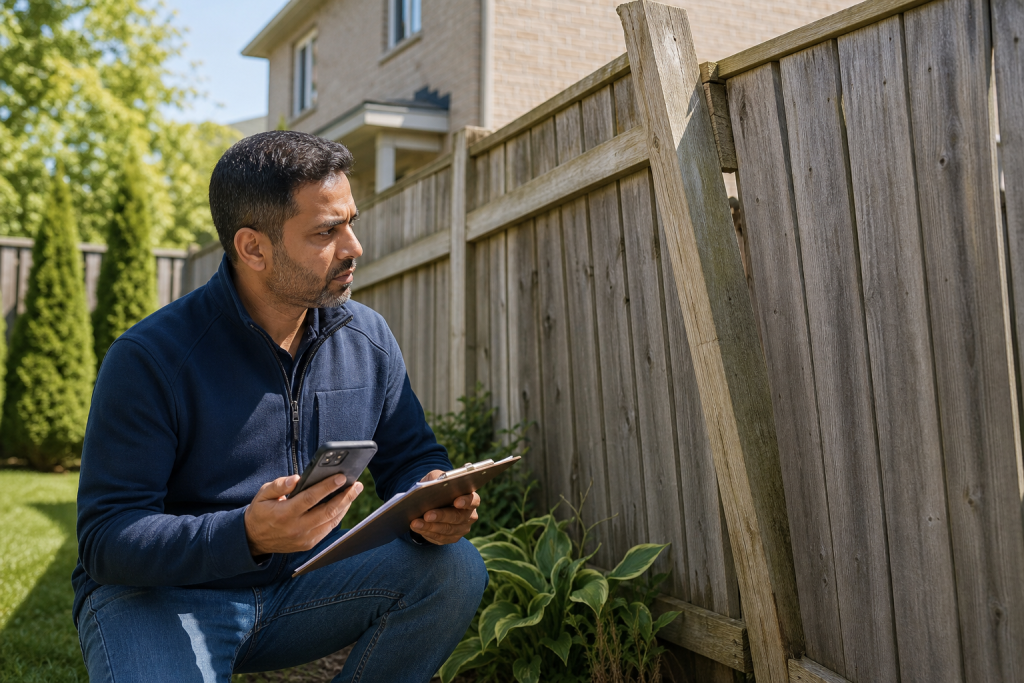
Examine each post from more than one angle. Look for leaning, visible movement, cracks, deterioration near the base, or a fence line that has become uneven around a support. A post problem can appear alongside loose boards or a sagging section, so record both the support and the connected components.
A post concern is different from a surface blemish. If a post appears compromised, several adjoining sections are shifting, or the issue returns after a temporary adjustment, seek fence post repair advice rather than treating only the visible board. Immediate Fence Repair offers dedicated wood fence post repair. You can also review its resource on wood fence post repair options.
2. Inspect boards, panels, and rails for deterioration

Look for loose, cracked, warped, missing, or visibly deteriorated boards and panels. On wood, compare adjoining boards. On composite, note cracked or separated panels. With chainlink fencing, record bent or visibly compromised sections rather than focusing only on the overall appearance.
One damaged component may point to targeted wooden fence repair, while similar deterioration across adjoining sections may justify a broader assessment. Immediate Fence Repair provides wooden fence repair guidance and composite fencing services.
3. Review fasteners, joins, and visible connections
Look closely where boards, panels, rails, and supports meet. Record separated boards, loose-looking joins, missing or exposed fasteners, and sections pulling away from their supports. You do not need to diagnose the exact hardware problem; identifying where a connection no longer looks secure is enough to make the inspection useful.
Pay attention to repeated connection issues. A single loose component may be isolated, while similar separation across several sections can indicate that the problem deserves a broader review. Include these observations in any request for wooden fence repair.
4. Test the gate’s alignment, movement, and hardware condition
Observe whether each gate appears aligned, drags, sags, leaves an unusual gap, or is difficult to open and close. Note loose-looking hinges, a latch that does not meet properly, damaged gate boards, or any visible connection between the gate problem and a nearby post.
A gate may need focused repair even when most of the fence remains serviceable. If the surrounding post or fence section has shifted, however, a wider assessment may be appropriate. Immediate Fence Repair offers custom wooden fence gate services, so include photographs of the gate and adjacent posts when requesting advice.
5. Examine lattice, privacy features, and noise-wall sections
Inspect lattice and other privacy features for cracks, detached pieces, open gaps, or sections that no longer sit properly. These elements affect both appearance and the privacy layout you chose.
If your property includes a cedar noise-wall section, note visible damage, separation, or gaps separately. A checklist cannot confirm how much sound a particular configuration blocks. For a lattice concern, review these fence lattice repair considerations before requesting an assessment.
6. Assess the surface condition for the fence material
Finish the physical inspection by considering material-specific signs visible from both accessible sides.
- Wood: note splitting, discolouration, peeling, staining, or other visible changes in boards, rails, and posts.
- Composite: record cracks, separation, or damaged panels and compare them with nearby panels.
- Chainlink: note bent, broken, or visibly compromised sections and apparent gaps in the fence line.
This is an observation step, not a diagnosis of material performance or remaining service life. Immediate Fence Repair provides composite fence decision guidance and chainlink fencing services.
7. Document the damage and decide on the next step
Photograph each affected area from a wider view and a closer angle. Note the material, approximate location, whether the problem is isolated or repeated, and any gate or access concerns.
| What you observe | Reasonable next step |
|---|---|
| A limited surface or component issue with no obvious spread | Record it, follow appropriate material care, and monitor changes. |
| One damaged post, gate, panel, lattice area, or connection | Ask about targeted repair or component replacement. |
| Several compromised posts or sections, repeated connection problems, or widespread deterioration | Request an assessment that considers repair and replacement options. |
There is no need to choose between repair and replacement before the condition has been assessed. If you are considering a new wood fence, review this new wood fence installation checklist.
Use the checklist to plan the right next step
A systematic inspection helps separate a cosmetic concern from a damaged component or a problem affecting several parts of the fence. Posts, boards, connections, gates, lattice, and material condition each tell you something different. However, a visual checklist cannot confirm hidden conditions or prove that a fence is structurally sound.
Before requesting advice, gather photographs, identify whether the fence is wood, composite, or chainlink, and note the affected area. Immediate Fence Repair is based at 25 Agnes St #309 in Mississauga and offers callback requests and appointments for fence repair, post repair, replacement guidance, and related fencing services across the GTA. Request a callback or book an appointment when you are ready to discuss the next step.