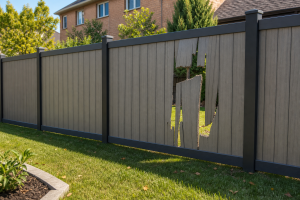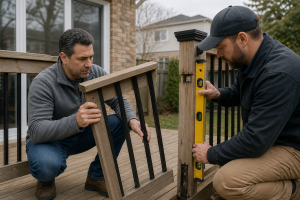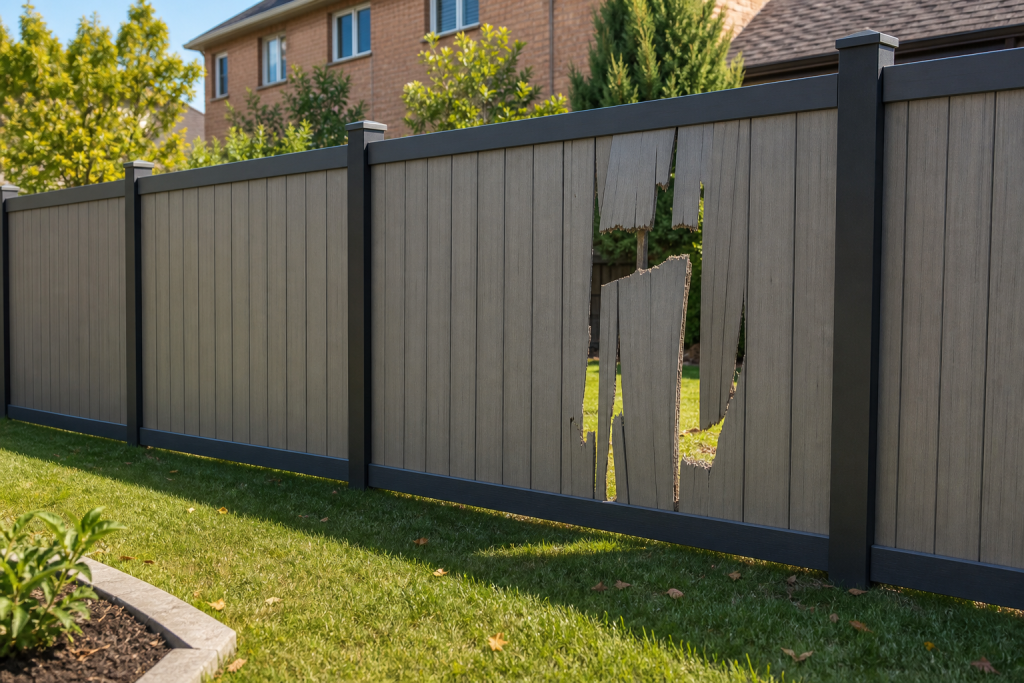
Composite fence repairs involve restoring damaged, loose, misaligned, or worn parts of a composite fence rather than automatically replacing the entire installation. The right solution depends on what has failed, how widely the damage extends, whether the fence remains stable, and whether replacement components can be matched appropriately.
For homeowners in Mississauga and the GTA, the key decision is whether the affected part can be repaired while the surrounding fence continues to provide the appearance, function, and security you expect.
What composite fence repairs involve
Composite fence repairs are intended to restore a damaged composite fencing system. Depending on its condition, the work may involve affected panels or sections, connections, gates, alignment, or appearance-related deterioration.
Repair can also be considered alongside maintenance. Cleaning, sealing, and staining are identified as composite fencing services offered by Immediate Fence Repair, but these treatments are not substitutes for correcting a broken, unstable, or structurally compromised section.
The important distinction is between a surface concern and a problem affecting how the fence stands, connects, closes, or performs. A professional assessment can help separate those issues when the cause is not obvious.
Repair or replace: the decision homeowners need to make

Repair is often the more focused option when damage is limited to one component or a small area and the rest of the fence remains in suitable condition. Replacement may become more practical when several connected sections are affected, damage keeps recurring, or existing materials are difficult to match.
| Consideration | Why it matters |
|---|---|
| Extent of damage | A localised issue may have a different solution from damage spread across multiple sections. |
| Stability | A fence that moves, leans, or has loose connected parts may need more than an appearance-focused repair. |
| Adjacent sections | Older or deteriorating neighbouring components can affect whether a small repair will provide a lasting result. |
| Visual matching | A replacement component needs to work with the existing colour, profile, finish, and layout as closely as possible. |
| Gate operation | A gate that drags or does not close properly may indicate a local gate issue or a wider alignment problem. |
There is no universal rule determining when a composite fence must be replaced. The decision should account for the fence as a system, not just the most obvious damaged piece.
When comparing repair and replacement options for a broader exterior project, it can help to consider material, scope, and contractor implications together. This comparison of exterior renovation choices in Ontario provides useful context for that type of decision.
What to check before arranging composite fence repairs
You do not need to dismantle the fence to gather useful information. A careful visual check from a safe position can help you describe the problem and identify whether it appears isolated or widespread.
- Stability: Look for sections that move unusually. Do not lean against an unstable fence or force it back into position.
- Alignment: Check whether the fence line appears uneven, tilted, or out of alignment with adjacent sections.
- Visible cracks or breaks: Note damaged panels, rails, posts, connections, or other visible components.
- Loose sections: Identify parts that appear separated, rattling, or no longer securely connected.
- Gate operation: Observe whether the gate opens, closes, and sits correctly without dragging.
- Surface condition: Record staining, dirt, fading, or other appearance concerns separately from stability issues.
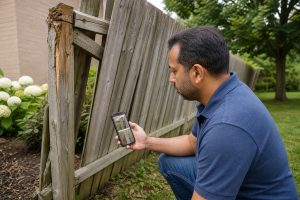
- Extent: Photograph the affected areas to show whether the problem is confined to one location or appears throughout the fence.
Take photographs in good daylight, including one wider image showing the fence line and closer images of each concern. Avoid attempting repairs if a component is unstable, sharp, broken, or difficult to access safely.
When professional composite fence repairs make sense
Professional help is sensible when more than one section is affected, the fence is unstable, looseness keeps returning, the gate no longer operates correctly, or you cannot determine where the problem begins. It is also useful when repairs require matching existing composite fence panels or coordinating several connected components.
A professional can assess the visible damage in relation to the surrounding fence and explain whether a targeted repair, component replacement, maintenance treatment, or larger replacement scope is appropriate. For more involved damage, composite fence repairs may help restore panels’ appearance, strength, and durability, subject to an assessment of the property.
Do not assume that cleaning or sealing will resolve a panel that is broken, detached, or affecting stability. Appearance-related maintenance and physical repair address different problems, although they may be considered together when the fence needs broader attention.
Arranging an assessment in Mississauga and the GTA
Immediate Fence Repair is a Mississauga-based fence and deck company serving homeowners and businesses across the GTA. Its verified service offering includes composite fence installation and composite fence repair, and the company accepts inquiries for fencing and deck projects through its website.
When requesting an assessment, describe what you noticed, when the issue became apparent, and whether it followed weather, an impact, or another identifiable event. Include photographs of the full fence line and close-ups of damaged areas, gates, connections, or alignment concerns.
Ask for the proposed scope of work rather than assuming the entire fence needs replacement. Project pricing and timing depend on the property’s actual condition and requirements, so confirm those details directly.
Frequently asked questions about composite fence repairs
Can one damaged composite fence panel be repaired without replacing the entire fence?
Possibly. If the problem is isolated and the surrounding fence remains stable, a targeted repair or component replacement may be considered. Feasibility also depends on the panel design, connections, adjacent sections, and how closely a replacement can match.
How can I tell whether composite fence damage affects stability?
Look for unusual movement, leaning, separation between connected components, misalignment, or a gate that no longer sits and closes properly. These signs do not establish the cause, so avoid forcing the fence and request an assessment if it appears unstable.
Is composite fence maintenance different from composite fence repair?
Yes. Maintenance may address cleaning, sealing, staining, and general appearance, while repair addresses physical damage, loose components, alignment, or operation. A fence may need one type of work or a combination.
What information should I provide when requesting an assessment?
Provide the property location, photographs, number of affected sections, a description of what changed, and any gate or alignment problems. Mention whether the fence is moving or unsafe to approach.
Make the repair decision after checking the whole fence
Composite fence repairs are best understood as a condition-based decision. Check visible damage, stability, alignment, gate operation, surface condition, and how many sections are involved. A repair may suit a contained problem, while widespread deterioration or difficult matching may make larger-section replacement more practical.
If the cause or extent is unclear, do not base the decision on one broken or discoloured component alone. Gather photographs and request an assessment so the proposed work reflects the complete fence.
For composite fence repairs or installation inquiries in Mississauga and the GTA, contact Immediate Fence Repair to discuss the affected areas and request an assessment or quote.