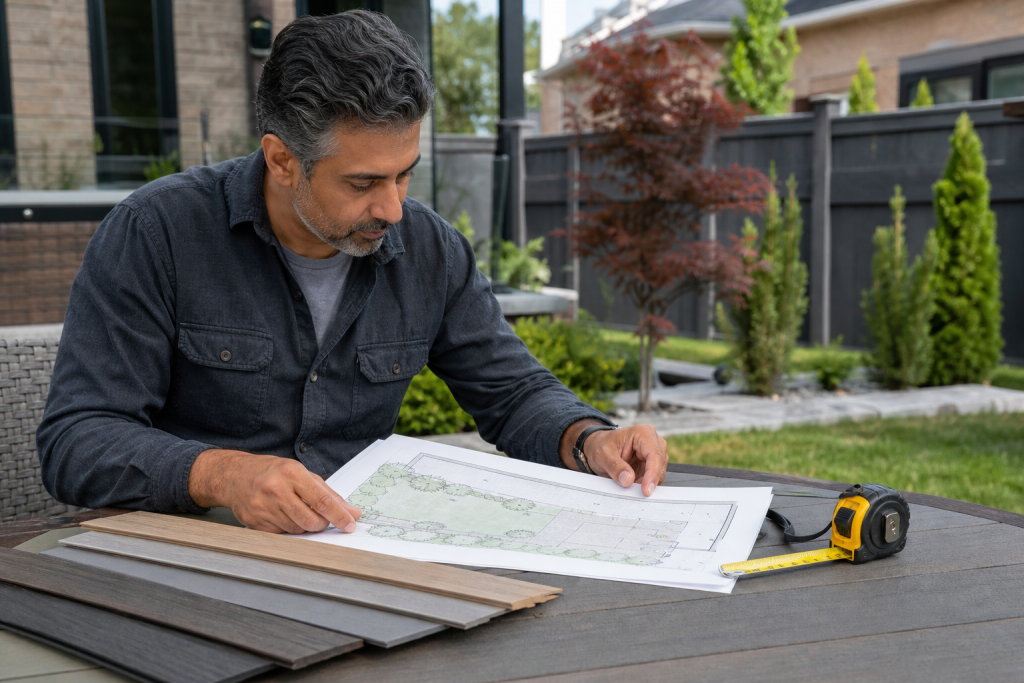
Successful composite fence installation involves more than assembling panels. Before digging, decide whether composite suits the property, confirm Mississauga requirements, settle the fence line, locate utilities, plan gates and grade changes, and follow the selected product’s instructions.
1. Decide whether composite fencing fits your property
Composite fencing may suit homeowners who want a consistent appearance and less routine upkeep than painted or stained wood. However, upfront cost, colour and style options, product availability, gate requirements, and site conditions should all be part of the decision.
| Consideration | Composite fencing | Wood fencing |
|---|---|---|
| Routine care | Often selected for a lower-maintenance approach, subject to the product’s care instructions. | May require cleaning, staining, painting, or repairs as it weathers. |
| Appearance | Provides a consistent manufactured finish determined by the product line. | Offers natural grain and can be painted or stained. |
| Installation | Requires product-specific posts, rails, fasteners, spacing, and assembly details. | Requires careful layout, post setting, alignment, and suitable construction methods. |
For a closer look at material benefits, durability, and maintenance expectations, review the benefits of composite fence installation before choosing a design.
2. Check Mississauga height, permit, and approval requirements

Do this before ordering panels or finalizing the layout. The City of Mississauga states that fences in a back yard or side yard may be up to 2 metres high. Front-yard fences may be up to 1 metre high, or up to 1.5 metres for open construction, subject to applicable requirements. Review the city’s fence height requirements for current rules and conditions.
Do not assume that a fence always needs a building permit or never needs one. Property location, height, construction, zoning, and other approvals can affect the answer. Check the city’s information about when a building permit is required.
Stop point: Do not finalize the fence height or begin installation until applicable local requirements are confirmed.
3. Settle the property boundary before digging
A fence that appears to follow a boundary may still be in the wrong location. Review your property information and determine whether the proposed fence is entirely on your property or intended as a division fence.
For a shared boundary, discuss the location, height, material, style, gates, and cost sharing with the adjacent owner. Mississauga’s division-fence procedure encourages neighbouring owners to attempt agreement before proceeding under the applicable by-law process. Ontario’s Line Fences Act information explains procedures that can apply to many boundary-fence disagreements.
Stop point: If the boundary, ownership, or cost-sharing arrangement is disputed, pause until the issue is documented or resolved.
4. Locate utilities and assess the installation site
Before digging post holes, arrange utility locating and identify buried services. Review the composite fencing installation instructions alongside local safety and approval information.
Walk the proposed line and note slopes, retaining walls, drainage, trees, sheds, equipment, existing posts, narrow access points, and material-carrying routes. Slopes and obstacles can affect post locations, panel alignment, and gate operation.
Stop point: Do not dig where utilities are unconfirmed, access is unsafe, or the site may require a structural solution you do not understand.
5. Plan the layout, posts, and gates
Create a site plan showing the approved fence line, corners, ends, direction changes, transitions, and every gate opening. Measure each run separately instead of assuming one panel arrangement will work throughout the property.
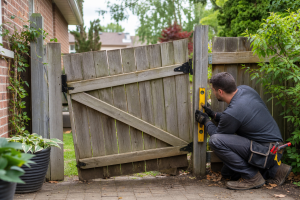
Plan gate width, swing direction, clearance, latch position, hardware, and support requirements. Ground slope and inaccurate post alignment can cause a gate to bind.
Do not copy post spacing, footing dimensions, fasteners, or panel clearances from another composite product. Use the selected manufacturer’s instructions.
6. Follow product-specific installation instructions
Composite systems differ in post profiles, rails, boards, caps, brackets, fasteners, and assembly sequence. Check that the kit contains the expected components and that the instructions identify the correct orientation and order.
Composite materials can expand and contract as temperatures change, so specified spacing and attachment methods matter. Substituting hardware or leaving too little room may affect appearance, movement, safety, or warranty coverage.
Stop point: If instructions are missing, unclear, or inconsistent with the delivered components, stop before cutting or fastening anything.
7. Prepare and install with alignment checks
The exact construction sequence must come from the selected product. Generally, work progresses from an approved layout to post locations, aligned posts, rails and boards, transitions, and gates. Check each stage before moving on.
- Reconfirm the marked fence line and gate openings.
- Prepare post locations according to the product instructions.
- Check post position and alignment before installing adjoining components.
- Install rails and boards in the specified orientation and maintain clearances.
- Inspect corners, transitions, and gate supports as work progresses.
- Test gate movement, latch operation, and clearance.
Check level, plumb, consistent spacing, secure components, and clean transitions regularly. Correcting a small alignment error early is easier than dismantling finished sections.
Stop point: Seek professional help if the line is disputed, utilities are uncertain, the grade is complex, or a gate requires support beyond the product instructions.
8. Decide whether to install it yourself or hire help
DIY installation may suit a straightforward project with a confirmed property line, clear access, known utilities, complete instructions, manageable grade, and a homeowner comfortable with accurate layout and safe digging.
Professional installation is more appropriate when the fence is on a boundary, the site slopes significantly, access is restricted, gates are complex, utilities are uncertain, or requirements are difficult to interpret.
Immediate Fence Repair is a Mississauga-based fence and deck company with composite fence installation listed among its services. Its broader offering includes fence repair, post repair, wood fencing, chainlink fencing, gates, and deck services.
9. Inspect and maintain the finished fence
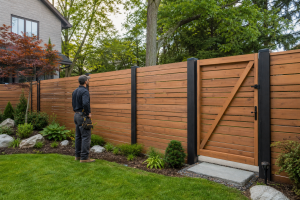
Before considering the installation complete, inspect the full line in daylight. Confirm that posts and panels are aligned, components are secure, gates operate without binding, and latches engage correctly.
Keep product instructions, purchase records, warranty information, and approval documents together. Follow the manufacturer’s cleaning and care requirements. Composite fencing may reduce routine upkeep compared with some wood systems, but it is not maintenance-free.
If a section needs attention after installation, the FAQ explains when composite fence repairs and fence maintenance may be appropriate. Avoid modifying components without checking the product instructions.
Troubleshooting checklist for common problems
| Problem | First response | When to seek help |
|---|---|---|
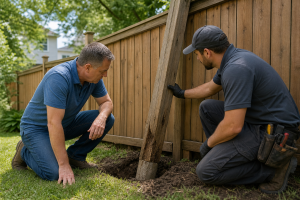
| Leaning post | Check whether movement is at the post, footing, connector, or adjoining panels. | Arrange an assessment if the post is unstable or the cause is unclear. |
| Loose panel | Compare the assembly with the product instructions. | Seek advice before adding substitute fasteners or drilling new holes. |
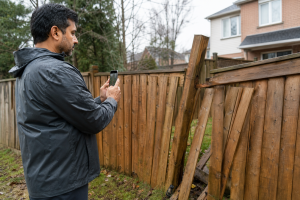
| Damaged component | Photograph the damage and retain product information. | Ask about compatible replacement parts and warranty implications. |
| Poor alignment | Check post position, grade, transition, and required spacing. | Get help if correction requires dismantling completed sections. |
| Gate will not close | Check clearance, hardware, ground interference, and post alignment. | Arrange an assessment if adjustment does not resolve the issue. |
Composite fence planning checklist
- Compare composite and wood for maintenance, appearance, budget, and site conditions.
- Confirm Mississauga height, zoning, permit, and approval requirements.
- Verify the property line and communicate with neighbours where relevant.
- Arrange utility locating before excavation.
- Map corners, ends, gates, slopes, obstacles, and access routes.
- Confirm product components, spacing, hardware, and warranty conditions.
- Inspect alignment, security, transitions, and gate operation.
- Store documents and plan appropriate cleaning and maintenance.
Frequently asked questions
Does a composite fence need a permit in Mississauga?
Not every fence project has the same requirements. Height, location, zoning, construction details, and property circumstances can affect what applies. Check the City of Mississauga’s current fence and permit information before beginning work.
Is composite fencing suitable for a property boundary?
It can be suitable, but the material does not resolve the boundary issue. Confirm the line, discuss the proposal with the adjacent owner, and document agreements about location, appearance, and costs.
Why do composite installation instructions specify spacing?
Composite materials can expand and contract with temperature changes. Correct clearances help the system accommodate movement as designed. Use the exact spacing for the selected product.
When should a damaged composite fence be professionally assessed?
Seek assessment when posts lean, multiple panels are loose, a gate no longer works correctly, the cause is unclear, or repairs could affect structural stability or warranty coverage.
Conclusion
Composite fencing can be a practical low-maintenance option for a Mississauga property, but installation should begin with verification rather than digging. Confirm local requirements, settle the boundary, locate utilities, map the site, plan gates and grades, and follow the selected product’s instructions.
Proceed with DIY work only when the site and instructions are clear. For uncertain boundaries, difficult grades, complex gates, or installation concerns, a professional assessment can help avoid costly rework. Immediate Fence Repair offers composite fence installation in Mississauga.