Horizontal board-to-board fence design is a residential fencing style in which boards run horizontally across the fence instead of vertically from the ground upward. The arrangement creates a distinctive, often contemporary appearance, but the right choice depends on more than looks. Board spacing, fence height, privacy goals, gate requirements, property style, and the condition of an existing fence all matter.
This article explains what the design means, how it compares with common alternatives, and what to assess before choosing installation, repair, or replacement.
Key Takeaways
- Horizontal board-to-board fencing uses boards that run side to side rather than up and down.
- Spacing and height determine how open or enclosed the fence feels, so the style does not automatically provide complete privacy.
- Vertical, semi-privacy, and full-privacy designs may suit different properties and priorities.
- Before requesting a quote, assess the existing posts and boards, decide how much privacy you need, and plan gates at the same time.
- Consider the maintenance and repair options available to ensure the longevity of your fence.
What does horizontal board-to-board fence design mean?
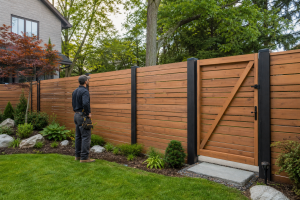
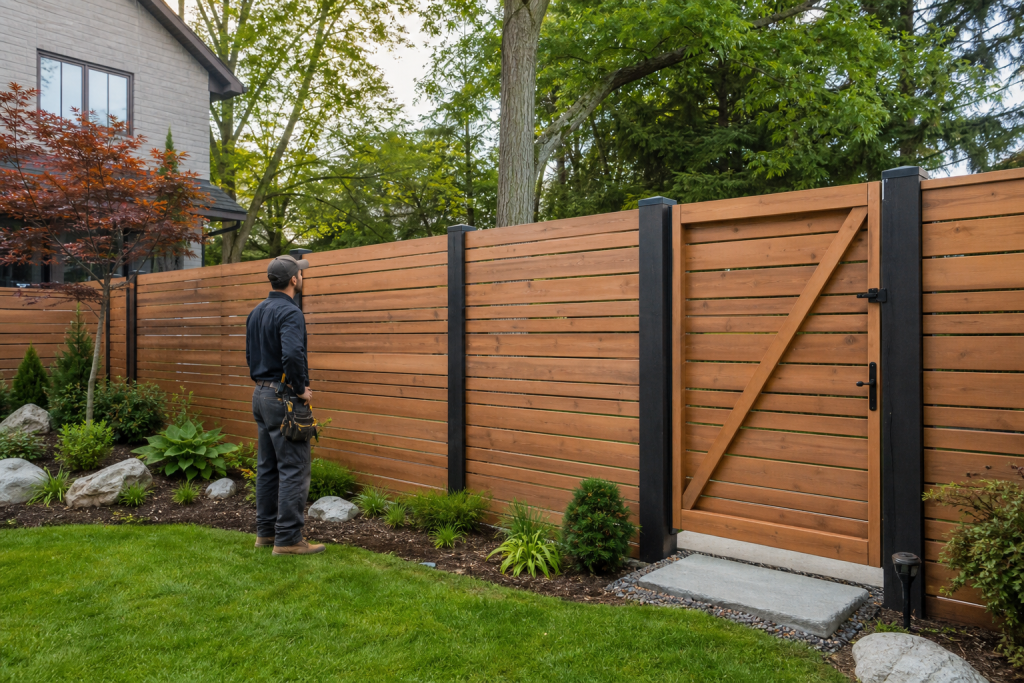
In a horizontal board fence, parallel boards run across the fence line while posts and supporting components hold them in place. The spacing between the boards determines how much of the property and surrounding area remains visible.
“Board-to-board” describes the arrangement, not one fixed privacy level. Small gaps can create a more enclosed appearance, while wider spacing leaves more visibility and openness. Fence height, neighbouring sightlines, ground slope, and gate placement also affect the final result.
For that reason, horizontal board fencing is a layout choice rather than a guarantee of a particular performance level. The same general orientation can be adapted to a more open boundary, a semi-privacy fence, or a more enclosed privacy design.
How horizontal board fencing compares with other designs

Comparing the arrangement with other fence styles makes the decision clearer. The key differences are visual direction, openness, privacy, and how well the design fits the property.
| Fence design | Visual arrangement | Often considered when | Key question |
|---|---|---|---|
| Horizontal board | Boards run across the fence | You want a distinctive, contemporary appearance | How much spacing and enclosure do you need? |
| Vertical board | Boards run from the ground upward | You prefer a conventional appearance or need to match an existing boundary | Will it suit the home and neighbouring fences? |
| Semi-privacy | Boards have intentional gaps | You want separation without a fully enclosed boundary | What can people still see through the gaps? |
| Full privacy | Boards limit direct visibility | Privacy and enclosure are the main priorities | Will the enclosure suit the yard and access points? |
Horizontal versus vertical board fencing
The most obvious difference is direction. Horizontal lines can draw the eye along the property and create a different relationship with the home’s exterior, landscaping, and neighbouring fences. Vertical boards create an upright visual rhythm and may be easier to match when nearby properties already use that arrangement.
Neither orientation is automatically right for every property. Consider the view from inside and outside the yard, how the fence will meet the house or deck, and whether the selected spacing provides the privacy you expect. Maintenance and repair decisions should be based on the actual condition and materials, not orientation alone.
Semi-privacy and full-privacy options
Horizontal boards can be planned with varying gaps, but semi-privacy and full privacy should be treated as design goals rather than assumptions. A semi-privacy layout may allow light, airflow, and partial views, while a more enclosed layout is intended to reduce direct sightlines.
Immediate Fence Repair identifies semi-privacy wooden fencing, full-privacy wooden fencing, and horizontal board-to-board designs among its residential fencing options. Comparing those choices during planning helps you select based on how the fence should function, not only on a reference image.
The practical tradeoffs to consider
Privacy, visibility, and airflow
Start by identifying what you want the fence to hide and what you are comfortable leaving visible. A fence beside a patio may need a different balance than a boundary along a driveway, front yard, or shared property line.
Look at sightlines from nearby windows, decks, walkways, and neighbouring yards. Horizontal board-to-board fencing does not automatically provide complete privacy, so confirm how the proposed spacing and height will work at the specific property.
Appearance and property style
Horizontal fencing is often considered for its clean lines and visually distinctive character. It may suit homeowners who want the fence to contribute to curb appeal rather than function only as a background boundary.
Compare the design with the home’s siding, deck, landscaping, gates, and neighbouring fences. Collect reference images showing the board direction and spacing you prefer. If the project includes an entry gate, review the gate and fence as one composition. A custom wood gate design can affect the appearance and access pattern of the entire fence line.
Security, boundaries, and gate planning
Visual privacy and physical security are related but different objectives. A fence may define the property and discourage unwanted access without completely blocking views, while a more enclosed layout may better support privacy around a backyard or outdoor living area.
Plan gate locations, widths, latching, and opening direction before installation begins. Consider how people, pets, vehicles, bins, and garden equipment move through the property. A well-designed fence can still be inconvenient if the gate does not match the way the space is used.
Maintenance, repair, and replacement
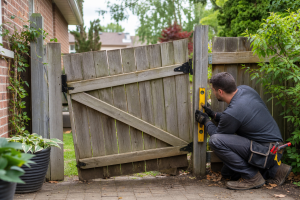
If you already have a fence, do not assume that a new design is necessary because the current boards look tired. Check whether the problem is limited to a few boards, a gate, or one or more posts. Several unstable sections, recurring leaning, widespread splitting, or posts that no longer hold the fence securely may indicate a broader issue.
Repair may make sense when the underlying structure is sound and the damage is limited. Replacement may be more appropriate when deterioration is extensive or when the desired horizontal layout cannot be achieved by modifying the existing structure. A fence post replacement assessment can help distinguish a local post problem from a wider fence condition issue.
Immediate Fence Repair identifies wooden fence repair, wood fence post repair, fence post replacement, composite fence repairs, and new fence installation among its services. An assessment can clarify whether the practical next step is a targeted repair, partial replacement, or a new residential fencing design.
Is a horizontal board fence right for your property?
Horizontal board fencing may be worth exploring if you want a clear, contemporary-looking boundary and are prepared to select spacing and enclosure carefully. It can be useful when appearance is an important part of the project alongside privacy and boundary definition.
Another design may be a better fit if your main goal is a specific privacy level, if you need to match an existing vertical fence, or if the current posts and structure require substantial work. Weigh these factors together:
- Privacy: Decide whether you want partial views, limited sightlines, or a more enclosed yard.
- Property style: Consider how horizontal lines will relate to the home’s exterior, deck, landscape, and neighbouring boundaries.
- Security and access: Identify gate locations and how residents, guests, pets, and vehicles use the property.
- Existing condition: Inspect boards, posts, gates, and sections that lean, loosen, split, or show deterioration.
- Maintenance: Ask what upkeep the chosen material and finish will require.
A decision checklist before requesting a quote
- Describe the main purpose of the fence, such as privacy, security, appearance, boundary definition, or a combination.
- Mark the sections where you want a fence, gate, repair, or replacement.
- Decide whether you prefer an open, semi-private, or more enclosed arrangement.
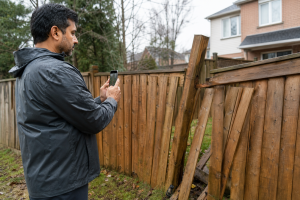
- Take photos of existing boards, posts, gates, connections, and damaged sections.
- Note access requirements for people, pets, vehicles, bins, and maintenance equipment.
- Collect reference images showing the horizontal board direction and spacing you like.
- Ask whether the current structure can be repaired or whether replacement is more suitable.
Questions to ask a fencing contractor
Ask how the proposed orientation and spacing will affect visibility, whether existing posts can be retained, what materials are available, and how the gate will be integrated.
Also ask which sections are included, whether repair and replacement are separate options, what preparation is required, how the timeline will be estimated, and what maintenance the finished fence will need. If a satisfaction guarantee or warranty is offered, request the applicable terms for the service and materials in writing. Immediate Fence Repair’s FAQ states that specific warranty terms depend on the service provided and materials used.
Frequently asked questions
Does a horizontal board-to-board fence provide complete privacy?
Not automatically. Privacy depends on board spacing, fence height, layout, surrounding sightlines, and the way the fence meets gates and neighbouring boundaries.
Can an existing vertical fence be changed to a horizontal board design?
It depends on the condition and arrangement of the existing posts, supports, sections, and property line. Horizontal boards may require different preparation, so an assessment is needed before assuming the fence can be adapted.
Is horizontal board fencing suitable for a property that needs a gate?
Yes, it can be considered alongside a wooden gate or another appropriate gate design. Plan the location, size, access needs, and visual relationship with the horizontal boards at the same time as the fence.
Should I repair my existing fence or replace it with a horizontal design?
Repair may suit limited damage and a sound underlying structure. Replacement deserves consideration when deterioration affects multiple sections, posts, or gates, or when the existing layout cannot deliver the appearance and privacy you want.
Conclusion: choose the layout that matches the property
Horizontal board-to-board fence design means arranging fence boards side to side rather than vertically. Its suitability depends on the balance you want between appearance, privacy, visibility, security, access, and maintenance. Compare the spacing and enclosure level with vertical, semi-privacy, and full-privacy alternatives before deciding.
For homeowners in Mississauga and the GTA, Immediate Fence Repair provides fence building, wooden fence repair, wood fence post repair, residential fencing, and related fence and deck services. Discuss your preferred horizontal design, existing fence condition, and repair or installation options with the team.