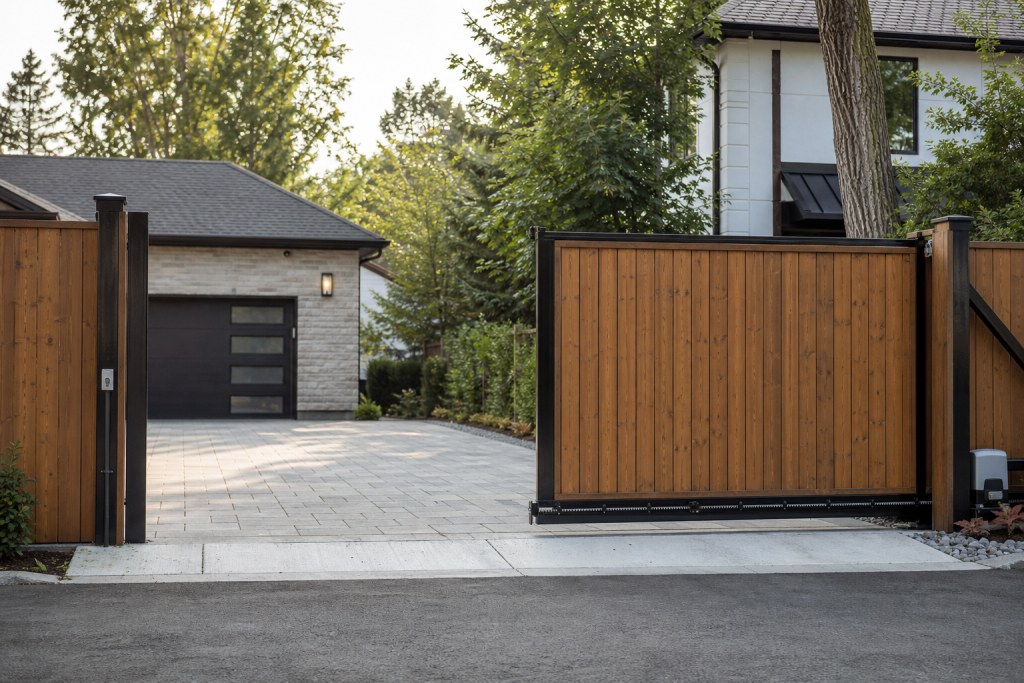
Sliding gate installation can be a practical choice when a gate needs to move along the fence line rather than swing across an entrance. The right decision depends on how you use the opening, the available movement space, the condition of the surrounding fence, and the gate design you want.
This guide focuses on wooden sliding gates for Mississauga and GTA properties. It explains what you can assess yourself, what should be left to a professional inspection, and how to prepare before requesting an installation assessment. It does not assume that automatic, powered, metal, cantilever, or access-control services are included.
Key Takeaways
- Sliding gates are ideal for properties with limited space for swinging gates.
- Inspect the surrounding fence and ground conditions to ensure proper installation.
- Prepare detailed information and photos before consulting a professional installer.
- Understand the maintenance requirements for wooden gates to ensure longevity.
- Ask specific questions about the installation process and materials used.
Quick summary

- Compare sliding and swing movement based on your access habits and the space around the opening.
- Inspect the opening, posts, adjoining fence panels, ground conditions, and visible damage before requesting an assessment.
- Decide on the wooden gate’s privacy level, board arrangement, proportions, and relationship to the existing fence.
- Prepare clear photos, approximate measurements, access requirements, and design preferences for the consultation.
- Ask how installation, alignment, movement testing, final fine-tuning, and ongoing maintenance will be handled.
Step 1: Decide whether sliding access fits the property
The first decision is not the gate’s finish or colour. It is whether sliding movement suits the way people, vehicles, and equipment use the entrance.
| Consideration | Sliding gate | Swing gate |
|---|---|---|
| Movement | Moves along the fence line or beside the opening. | Moves inward or outward from hinges. |
| Space to observe | Requires a suitable area beside the opening for the gate to travel. | Requires usable space in the direction of the swing. |
| Access pattern | May suit an entrance where swing movement would interfere with circulation. | May suit a simpler pedestrian or driveway opening where swing space is available. |
| Assessment need | Requires checking the fence line, supports, alignment, and travel path. | Requires checking hinges, posts, swing clearance, and surrounding obstructions. |
Walk through the opening as you would on a normal day. Consider where a vehicle stops, where people stand, whether the gate would obstruct a walkway, and whether snow, stored items, landscaping, or neighbouring structures could affect movement. These observations help define the project, but they do not replace a site assessment.
A sliding gate can be worth investigating when swing movement would be inconvenient, but the available travel path and the existing fence layout must support the design. For larger properties, broader access planning may also matter, although it is separate from the wooden gate installation itself.
Step 2: Check the opening and surrounding fence

Before requesting a quote, examine the gate opening from both sides. Note the approximate opening width, the height of the existing fence, the location of the posts, and the condition of the panels beside the proposed gate.
Look for leaning posts, loose boards, cracked wood, damaged lattice, uneven fence lines, and areas where the ground appears to have shifted. A new gate may not operate properly if the fence it connects to is unstable or badly out of alignment. In some cases, a repair or partial replacement may need to be considered alongside the gate.
Also observe the ground along the intended movement path. Do not assume that a level-looking surface, drainage pattern, support arrangement, or clearance is suitable without professional review. Alignment, support, hardware compatibility, and site preparation depend on the property and gate design.
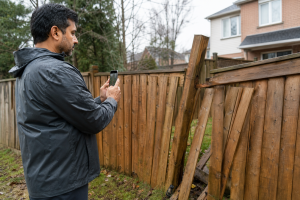
Take photographs from the approach side, the property side, both ends of the opening, and the area beside the fence where the gate would move. Include close-ups of damage and wider images that show the relationship between the opening, fence, driveway, walkway, and nearby features.
Step 3: Choose the wooden gate style and appearance
Once the movement arrangement is plausible, decide how the gate should look and relate to the rest of the fence. A gate that is structurally appropriate but visually unrelated can make the entrance feel unfinished.
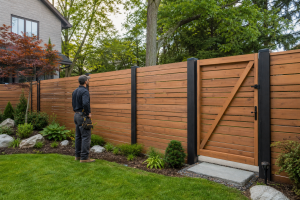
Useful design decisions include the desired privacy level, board direction, spacing, height, frame appearance, finish, and whether the gate should match existing fence panels or introduce a deliberate contrast. If the surrounding fence is older, ask whether matching materials are available or whether a complementary new design would be more practical.
Immediate Fence Repair describes customized wooden fence gate services that include classic swing gates and modern sliding models. Its stated scope also includes precision installation and fine-tuning for smooth operation. You can review the available wooden fence gate services when comparing design possibilities.
Keep the design discussion specific. Instead of saying that you want a “modern gate,” identify whether you prefer a clean horizontal appearance, a more traditional vertical arrangement, a privacy-focused surface, or a gate that visually blends with an existing wooden fence.
Step 4: Prepare for the site assessment
A good consultation is easier when the homeowner arrives with clear priorities and useful site information. Prepare the following before contacting an installer:
- The property address and the location of the proposed gate.
- The intended use, such as pedestrian access, driveway access, or both.
- Approximate opening width and fence height, even if your measurements are rough.
- Photos showing the opening, adjoining fence, ground, and proposed sliding path.
- Any concerns about leaning posts, damaged boards, drainage, landscaping, or obstructions.
- Your preferred privacy level, board arrangement, finish, and relationship to the existing fence.
- Questions about what the estimate includes and which related fence work may be required.
Immediate Fence Repair states that its wooden gate process includes a free consultation and detailed inspection. A professional assessment should help separate your design preferences from site conditions that need to be measured, checked, or corrected before installation.
Step 5: Confirm the installation plan before work begins
Before approving the project, ask for a clear explanation of the proposed design and the work included. The goal is to understand how the gate will relate to the opening, surrounding fence, movement path, and intended use.
Questions worth asking
- Is a sliding design suitable for this specific opening and fence layout?
- What existing fence or post repairs are needed before the gate is installed?
- How will the proposed design match or complement the current fence?
- Which materials, finishes, and visible hardware are included?
- What site preparation is included in the estimate?
- How will the gate’s movement and alignment be checked at completion?
- What maintenance should be expected for the wood and moving components?
- What timing is realistic for this project’s scope and complexity?
- Does the proposal cover a manual wooden gate only, or are other systems being discussed separately?
Project duration should not be treated as a fixed promise before the site and scope are understood. Immediate Fence Repair’s FAQ states that timelines vary by project complexity, with minor repairs potentially taking a day and larger installations potentially taking several days. Ask for a project-specific estimate after the assessment.
Step 6: Understand installation and final fine-tuning
Precision matters because a gate must move through its intended path while remaining properly related to the fence and opening. Installation is not complete simply because the gate is attached. The finished assembly should be checked for alignment, movement, contact points, and the way it meets the closed position.
During the final review, ask the installer to demonstrate the gate’s full movement. Watch for rubbing, binding, uneven gaps, unexpected resistance, or movement that places strain on the surrounding fence. If something does not look or feel right, raise it before the crew leaves.
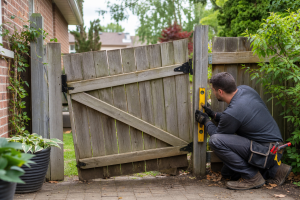
Immediate Fence Repair states that its wooden gate service includes precision installation, fine-tuning, and a final quality check. Those steps are valuable because small adjustments can affect how smoothly the gate operates and how consistently it closes.
Step 7: Plan for maintenance after installation
Wooden gates need periodic attention because they are exposed to weather, moisture, temperature changes, dirt, and everyday use. Maintenance may involve monitoring the wood finish, checking for movement or damage, keeping the travel area clear, and reporting changes in alignment before they become larger problems.
Inspect the gate and adjoining fence after significant weather and at regular intervals. Look for cracked or loose boards, changes in the gate’s movement, deterioration around connection points, and signs that the surrounding posts or panels are shifting.
Maintenance needs depend on the wood, finish, exposure, usage, and installation conditions. Immediate Fence Repair states that it offers ongoing maintenance support for its wooden gate services, so ask what care is recommended for the specific gate.
Pre-consultation checklist for sliding gate installation
- Access goal: Write down who will use the opening and whether it is for people, vehicles, or both.
- Site observations: Note the opening width, fence height, post condition, adjoining damage, and available movement area.
- Photos: Take wide and close-up images from both sides, including the proposed travel path.
- Design preferences: Decide on privacy, board direction, finish, proportions, and whether the gate should match the fence.
- Scope questions: Ask whether fence repairs, post work, preparation, installation, fine-tuning, and maintenance are included.
- Professional checks: Leave alignment, support, hardware compatibility, ground conditions, and final suitability to the site assessment.
Frequently asked questions
Can a wooden sliding gate be installed beside an existing fence?
Possibly, but the existing fence, posts, opening, and movement path need to be inspected first. Damage, instability, poor alignment, or an unsuitable layout may require repair or modification before the gate can be installed.
Does sliding gate installation include automatic or motorized operation?
Not necessarily. This article addresses customized wooden sliding gates and does not establish automatic, motorized, electrical, sensor, remote, or access-control capability. Ask the provider to define the exact system and services included in the proposal.
What should I send before requesting a sliding gate assessment?
Send the property location, intended use, approximate opening dimensions, preferred design, and clear photographs of the opening, surrounding fence, ground, and proposed movement area.
How does a professional check whether a sliding gate will operate smoothly?
The assessment should consider the opening, fence alignment, posts, available movement area, ground conditions, proposed materials, and the relationship between the gate and adjoining fence. The final installation should include movement testing and fine-tuning suited to the selected design.
How long can sliding gate installation take?
Timing depends on the scope, site condition, design, material availability, and any related fence repairs. A project-specific timeline should be discussed after the property has been assessed.
What maintenance does a wooden sliding gate need after installation?
Monitor the wood finish, boards, posts, movement, connection points, and surrounding fence. Keep the movement area clear and arrange an inspection if the gate begins to bind, rub, shift, or close differently than it did after installation.
Make the next decision with a site assessment
A sliding gate is worth considering when its movement pattern suits the entrance better than a swing gate. The decision should follow a review of the opening, surrounding fence, available movement area, access needs, wooden design, and any repairs required before installation.
For a Mississauga property, prepare photos and practical questions, then ask the installer to distinguish homeowner choices from site conditions that require professional assessment. Confirm what is included in the installation, how final movement will be tested, and what maintenance support is available.
Immediate Fence Repair is a Mississauga-based fence and deck company that describes customized wooden gate services, consultation, inspection, installation, fine-tuning, final quality checks, and maintenance support. Request an assessment to discuss whether a wooden sliding gate suits your property and access needs.